-
Amir Ali

- 202
The brand voice document exists. Somewhere in a shared drive there's a PDF with three adjectives, a "we are / we are not" table, and a paragraph about being "human but professional." The freelancer writing your blog has never opened it. The person writing your LinkedIn posts is referencing a different version from 2021. Your email sequences sound like a different company wrote them.
This is not a documentation problem.
Why Your Brand Voice Guide Isn't Working
The three-adjective trap
Most brand voice guides start with the same exercise: pick three to five adjectives that describe how you sound. Bold. Friendly. Expert. Approachable. These words end up in a document that gets shared once and then gradually ignored because they describe a feeling but give no instruction on how to produce it.
A writer drafting a blog section doesn't need to know you're "bold." They need to know how many words your typical sentence runs, whether you use second-person throughout or shift into third for authority, whether you open sections with a claim or a question. Feelings don't guide sentence-level decisions. Rules do.
Describing feeling versus specifying method
There's a real gap between "sound confident" and "don't hedge claims with phrases like 'it could be argued.'" The first is an aspiration. The second is a rule a writer can apply at the exact moment they're deciding how to phrase something.
Real brand voice documentation looks less like a mood board and more like a grammar guide. It specifies the patterns that produce the feeling, not the feeling itself. Until the guide makes that translation, it lives in a drawer and does nothing.
What Brand Voice Actually Is at the Sentence Level
Voice versus tone, the distinction that changes everything
Voice is stable. It's who you are regardless of context. Tone shifts based on situation. The same brand voice should be present in a thought leadership post and in an error message, but the tone in each will be different.
Most inconsistency problems are actually tone problems being misdiagnosed as voice problems. A brand that sounds clinical in blog posts but casual on social media doesn't necessarily have a broken voice. It may have a poorly defined tone framework that nobody has drawn a map for. Fixing the wrong thing wastes months.
The grammatical fingerprints of consistent brands
Pick any piece from a brand with genuinely consistent voice and you'll find repeating patterns at the sentence level. How they handle evidence. How they open paragraphs. Whether they address the reader directly or refer to "teams" and "marketers" in the third person.
These are grammatical choices, not stylistic preferences. They create recognition across pieces the way a musician's chord progressions create recognition across albums. When multiple writers don't share those patterns, the content sounds assembled rather than authored.
The Real Cause of Voice Drift
The ghost contributor problem
Here's what actually happens in most B2B content programs. A founder writes the first dozen pieces and establishes a voice through repetition. Then a content manager joins, hires two freelancers, and brings in a subject matter expert who contributes one post per quarter. Each person carries their own sentence-level instincts.
The founder's voice dilutes. No guide reverses that. A document cannot undo five different people's writing habits. Only an editorial system that processes every piece before publication maintains consistency at scale.
Why multiple writers aren't actually the root issue
The mistake is treating this as a people problem. The actual problem is the absence of a shared decision-making framework at the production level.
Multiple writers can produce consistent voice if they're working from sentence-level rules specific enough to guide real decisions. The goal isn't making every writer sound identical. The goal is making every piece recognizably the same brand. That's an editorial architecture question, not a hiring one.
What a Working Voice System Actually Contains
Sentence-level decision rules
A voice system that actually produces consistent output includes at minimum these four things: a vocabulary list of words the brand uses and words it does not, a structural rule for how paragraphs open and close, a position on how claims are evidenced, and a defined sentence length range by content type.
That last item is underestimated. Average sentence length is one of the most reliable signals of brand personality. A brand averaging 14 words per sentence sounds categorically different from one averaging 22, even when every other variable is the same.
The read-aloud calibration test
Before finalizing any piece, read a section from an established on-brand piece out loud. Then read a section from the new piece. Back to back. You'll hear the inconsistency before you can articulate it.
This test catches problems that editing passes miss. The eye compensates and normalizes on a screen. The ear doesn't. If the new piece sounds like a different person, it is a different person, and the system hasn't done its job yet.
Running a Voice Audit That Produces Actionable Output
What to compare and what to measure
Pull three pieces from each content channel: blog, email, social, website copy. Read them consecutively without looking at the channel label. Ask whether a reader could tell these came from the same organization if all branding were stripped.
Every gap you find is a decision point your current guide doesn't address. Each gap is a rule you haven't written yet. The audit works only when it produces a list of missing rules, not just a feeling that something is off.
Three questions every piece should answer
Does this piece address the audience the way you always address them? Does it open the way you open things? Does it handle evidence the way you handle evidence? If a writer can't answer yes to all three without stopping to think, the voice system is not specific enough to function as a production tool.
These questions turn voice consistency from a quality judgment into a checklist item. Quality judgments scale poorly across a team. Checklist items scale.
Making It Stick Across Channels
Channel adaptation without identity loss
The temptation when auditing inconsistency is to standardize everything to one register. That kills the content. A LinkedIn post and a 2,000-word technical guide serve different readers in different contexts. They should feel different.
The distinction is that they should feel like the same organization operating in different contexts. The way a person can be direct in a board meeting and warm at dinner without seeming to be two different people. The voice stays constant. The register shifts. The rules that govern the voice apply in both places.
The editorial review that doesn't require a full editor
Most content teams don't have a dedicated voice editor. What they can have is a two-question peer review before any piece publishes: does this sound like us, and if not, can you point to the specific line where it stops? That second question forces the reviewer to locate the problem rather than describe it.
The content programs Clienvora builds for B2B SaaS clients run this exact two-question review as a production step, not an afterthought. It catches the sentence-level decisions that no voice guide document alone would catch before a piece goes live. The results show in content that reads consistently across six months of output, not just the first batch.
The Fix Is Upstream of the Writing
The reason most brand voice consistency efforts fail is that they treat the symptom. A guide gets produced when the problem surfaces. The problem surfaces again six months later. The guide gets updated. The cycle repeats.
The guide was never the answer. A guide is a description of a desired output, not a system for producing it. What actually fixes it is the decision-making architecture built before any writer opens a new document.
At Clienvora, that architecture is the starting point of every content engagement, not a step that gets added after problems appear. The sentence-level rules, the calibration test, the peer review mechanism. These exist as production infrastructure. The voice doesn't drift because the system makes it harder to drift than to stay consistent.
If your content program is operating without that infrastructure, getting the production methodology right before scaling output is what separates a content program that compounds over time from one that has to be rebuilt every year.
Where This Leaves You
Inconsistent brand voice is not a writing quality problem. It's a production system problem. The writers aren't failing you. The architecture they're operating inside is failing them.
Build the sentence-level rules. Create the calibration test. Run the two-question peer review before anything publishes. The voice stops drifting not because everyone suddenly cares more but because the system now makes consistency easier than inconsistency.
That's the only fix that actually scales.
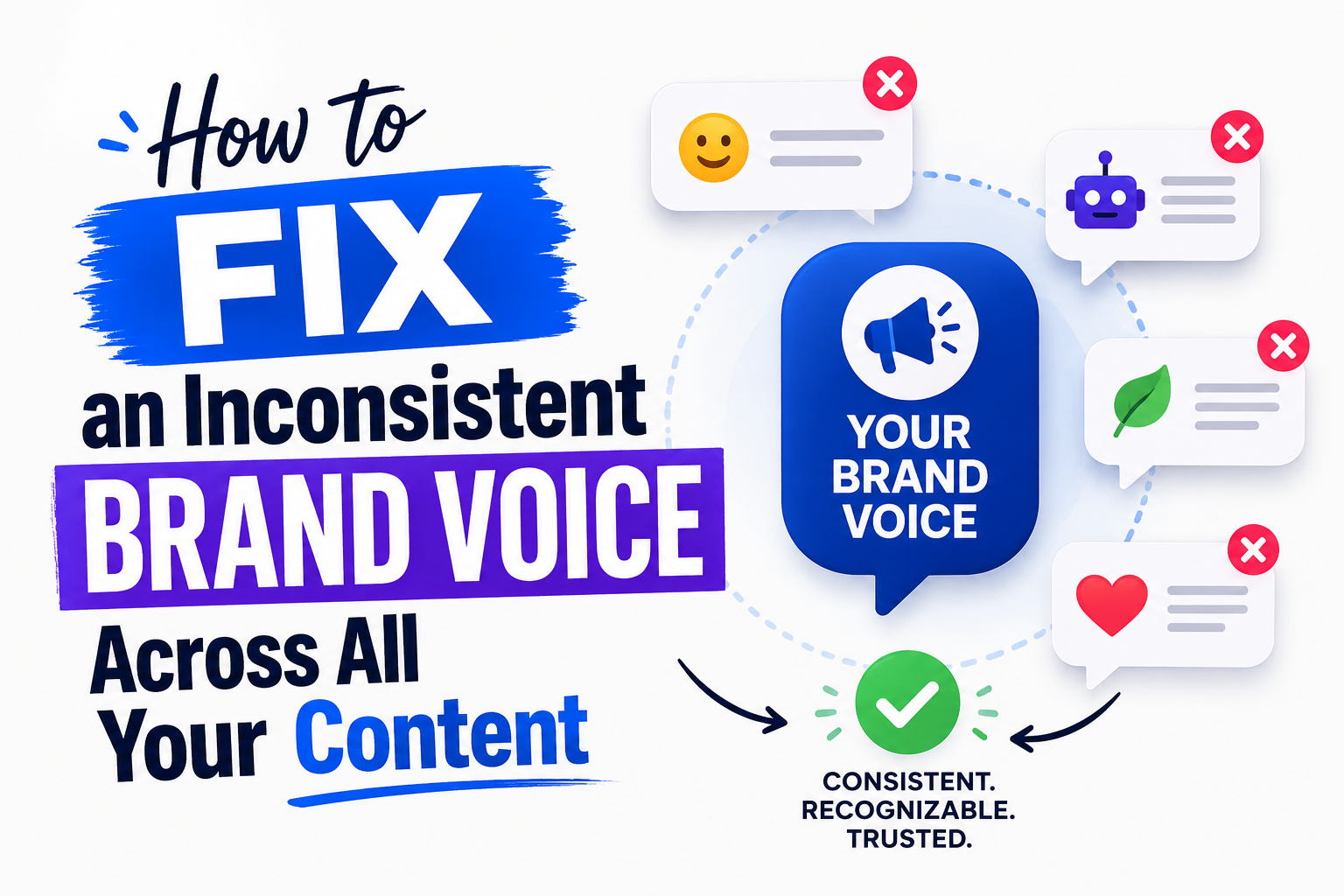
How to Fix an Inconsistent Brand Voice Across All Your Content's Tags :
Content Marketing Content Strategy B2B Content Content Consistency Brand Guidelines Content Operations SaaS Marketing Copywriting Editorial Strategy